Is Arizona Hard Water Making Your Hair and Skin Feel Dry?
How Arizona’s Hard Water Can Affect Your Hair, Skin, and Everyday Routine
You step out of the shower.
Your skin feels tight.
Your hair somehow feels both dry and heavy at the same time.
You bought the expensive shampoo.
You changed conditioners.
You tried another moisturizer.
And yet, something still feels... off.
Before you blame your beauty products, there may be another culprit coming straight out of the showerhead.
Your water.
Arizona is known for hard water, and while most homeowners notice the white spots on faucets or buildup around shower doors first, those same minerals are also coming into contact with your hair and skin every single day.
Sometimes the water problem is a lot more personal than a crusty faucet.
What Exactly Is Hard Water?
Hard water contains higher levels of dissolved minerals, primarily calcium and magnesium.
Those minerals are naturally present in water, but when there is a lot of them, they can leave deposits behind.
You see those deposits around your home as:
White buildup on faucets.
Spots on shower glass.
Scale around fixtures.
Residue on sinks and tubs.
But your plumbing fixtures are not the only things being rinsed with that water.
So are you.
Why Can Hard Water Make Your Skin Feel Different?
Have you ever stepped out of the shower and felt like your skin was strangely tight, even though you just spent ten minutes standing in water?
There is a reason that can happen.
Hard water can make it more difficult to completely rinse away soaps and cleansers. Research has found that washing in harder water can leave more surfactant residue on the skin, which may contribute to dryness and irritation for some people.
That does not mean hard water is automatically causing a skin condition.
It simply means the combination of hard water minerals and the products you use in the shower can sometimes leave your skin feeling less comfortable than you would expect after bathing.
And if you are immediately reaching for lotion after every shower?
Your water may deserve a little attention too.
And Then There Is Your Hair
Hair has its own relationship with hard water.
Minerals can accumulate on the hair shaft over time, and some research has found increased mineral deposits on hair washed in hard water.
For you, that may show up as hair that feels:
Dull.
Rough.
Heavy.
Harder to manage.
More difficult to lather and rinse.
Or like your shampoo and conditioner suddenly stopped doing their jobs.
Research into actual structural damage to hair from hard water has produced mixed results, so we are not going to tell you that hard water is secretly destroying your hair.
But mineral buildup?
That is real.
And if your hair never quite feels as clean or soft as you expect after washing it, the water itself could be part of the equation.
Why Does It Feel Like You Need More Shampoo and Soap?
This is another sneaky part of hard water.
When soap does not lather or rinse the way you expect, the natural response is usually:
Use more.
More shampoo.
More body wash.
More conditioner.
More cleaning products around the house.
And then you may still be left wondering why everything feels like it has a little bit of residue on it.
That is one reason homeowners often notice the difference in treated water very quickly.
It is not necessarily some dramatic moment.
Sometimes it is simply that the shower feels better.
The shampoo rinses differently.
The fixtures are easier to keep clean.
The glass does not seem to fight you quite as much.
Little things start feeling easier.
Your Showerhead May Be Telling You Something
Take a look at your showerhead.
Really look at it.
Are some of the little openings white or crusty?
Does the spray seem uneven?
Do you have mineral buildup around the edges?
That is the same water you are showering in every morning.
We usually notice hard water because of what it does to plumbing fixtures, appliances, water heaters, and glass.
But sometimes seeing that buildup makes homeowners stop and think:
If it is leaving all of that behind on my showerhead, what is happening everywhere else?
That is a pretty fair question.
Better Water Is About More Than Drinking Water
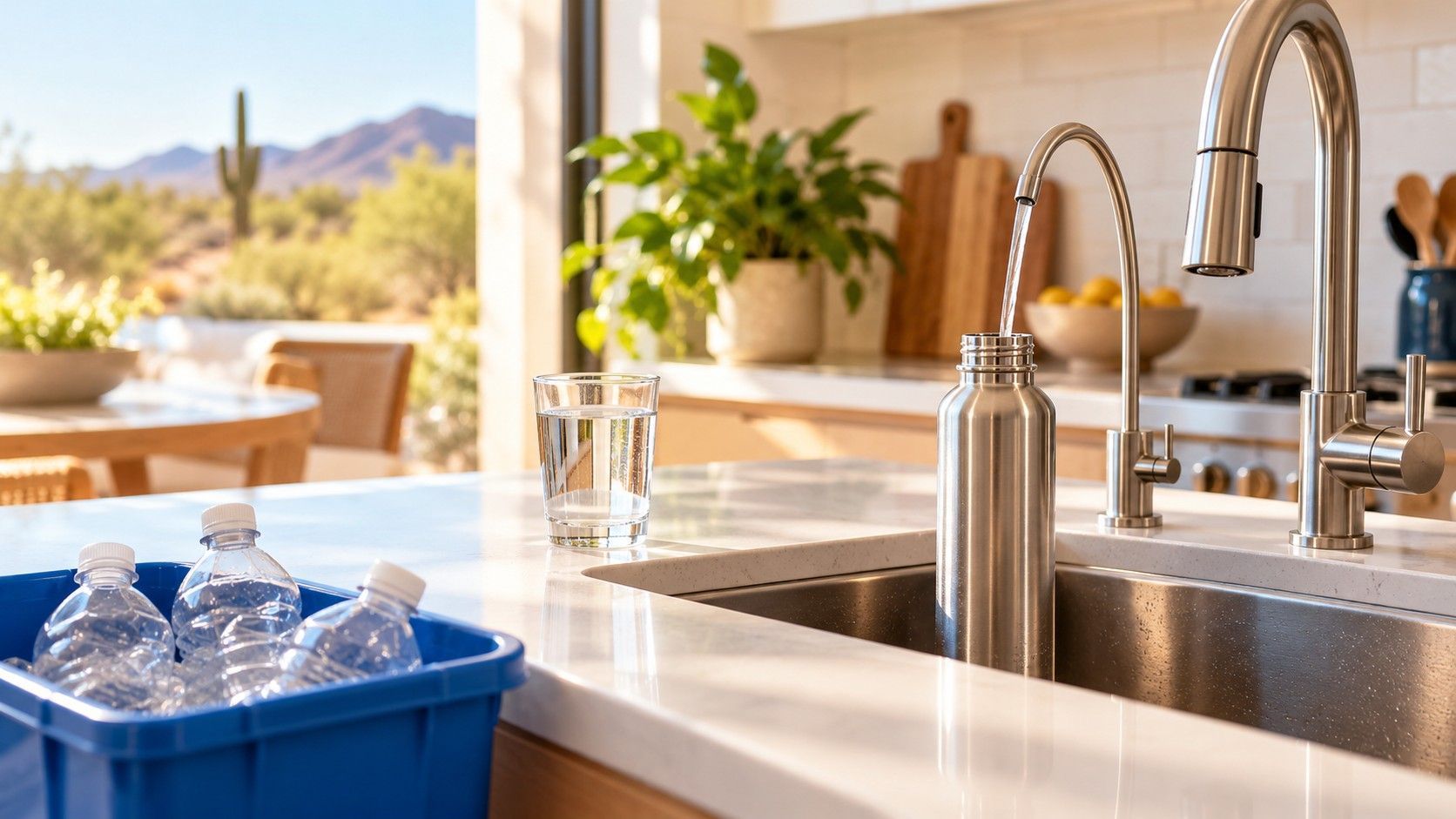
When people hear the words water filtration, they often think about the water coming out of the kitchen faucet.
And drinking water absolutely matters.
But think about how many ways you use water throughout your home.
You shower in it.
Wash your hair in it.
Brush your teeth with it.
Wash your clothes in it.
Clean your dishes with it.
Run it through your water heater.
Send it through faucets, fixtures, and appliances all day long.
That is why whole home water treatment can be so different from simply putting a filter under the kitchen sink.
It is about looking at the water throughout the entire house.
So Do You Need a Water Softener or a Filtration System?
This is where we want to make an important distinction.
Not every water treatment system does the same thing.
A traditional water softener is designed to remove hardness minerals such as calcium and magnesium from the water.
A whole home filtration system may be designed to reduce things like sediment, chlorine, taste, odor, or other water quality concerns.
Some systems also include scale protection, which is designed to help reduce the way hard water minerals form scale inside your plumbing and fixtures without actually removing those minerals from the water.
Those are different approaches to different problems.
And that is exactly why we do not believe homeowners should simply buy whatever water system has the prettiest box.
The right solution depends on your water, your home, and what you are actually trying to improve.
What About Plumbrite's Whole Home Water Treatment System?
Plumbrite Services offers several water treatment options, including whole home filtration systems, reverse osmosis systems, water softeners, and scale protection solutions.
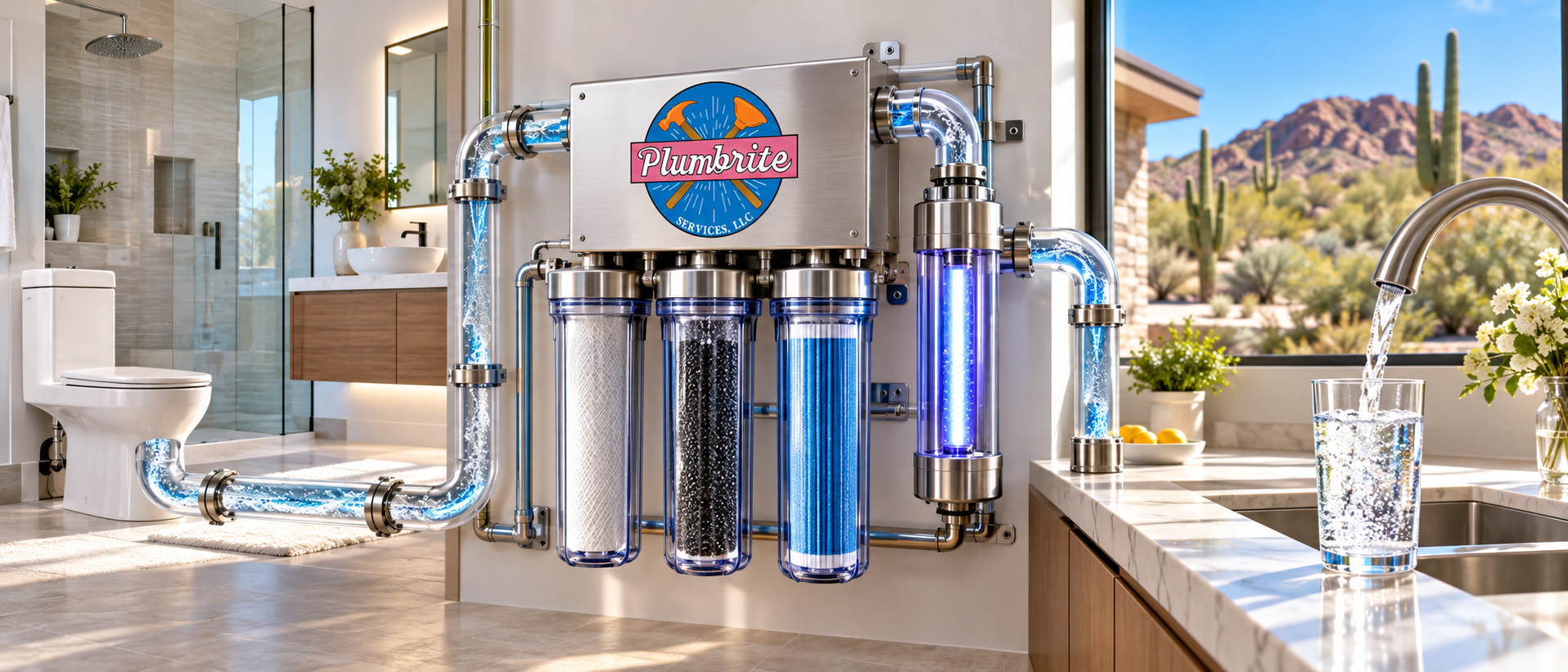
Our featured 3 in 1 whole home water treatment system combines sediment filtration, chlorine reduction, and salt free scale protection.
The scale protection component is designed to help reduce scale formation caused by hard water minerals.
It is important to understand that this particular system is not a traditional water softener and does not remove the hardness minerals themselves.
For some homeowners, that combination may be exactly what they are looking for.
For others who specifically want hardness minerals removed, a traditional water softener may be the better solution.
Our job is to help you understand the difference.
Maybe Your Hair Products Are Not the Problem After All
We are not suggesting you throw away your shampoo.
And we definitely are not getting between anyone and their favorite conditioner.
But if you have been battling dry feeling skin, dull hair, mineral buildup, water spots, and scale throughout your home, it may be worth looking beyond the products in your shower.
Sometimes the thing making your morning routine frustrating is not sitting on the shelf.
It is coming through the pipes.
Want to Know What Is in Your Water?
At Plumbrite Services, we help homeowners throughout Scottsdale, Fountain Hills, Paradise Valley, Cave Creek, Phoenix, and surrounding Arizona communities find water treatment solutions that actually make sense for their homes.
That may mean whole home filtration.
It may mean a traditional water softener.
It may mean reverse osmosis for drinking water.
Or it may mean a combination designed around the water you actually have.
Because better water should not just look better in a glass.
It should feel better throughout your home too.
If you want it done right, call Plumbrite.